Published July 31, 2026 02:17PM
If you buy through our links, we may earn an affiliate commission. This supports our mission to get more people active and outside.Learn about Outside Online's affiliate link policy
Trekking Pole Face-Off: Black Diamond Carbon Z FKT vs. Leki UltraTrail FX.One
I tested two leading trekking poles built for fast trail running. Here’s my head-to-head review.

(Photo: Lisa Jhung)
Look at the front of the field at a mountainous trail running race like Ultra-Trail du Mont-Blanc or the Hardrock 100 and you’ll notice a theme: nearly all the top competitors are running with trekking poles.
Not only that, they’re nearly all using one of two models: the Black Diamond Distance Carbon Z FKT or the Leki UltraTrail FX.One. These two super lightweight, collapsible pairs deploy easily and maximize power transfer, exactly what you need while running as fast as you can.
Thanks to these technological advancements, more American trail runners are catching on to using poles, long beloved by hikers, backpackers, fastpackers, and European trail runners.
I’ve used trekking poles for mountain running and trail escapades like multi-day adventure races for a couple of decades. I love them for their ability to distribute weight among four points of contact with the ground. I also appreciate how they help me climb steep ascents by giving me claws to dig into the ground in front of me, and that they add stability on descents and on technical terrain in general.
ADVERTISEMENT
Poles also can help keep you upright, especially when you’re super tired. They spread the load from your legs to your core and arms. Ultimately, they can help you go faster. But they can also be a pain in the butt to get on and off, store, eat and drink with, and there’s always the dreaded risk that one will snap.
The Black Diamond Distance Carbon Z FKT and the Leki UltraTrail FX.One promise to alleviate these pain points. Do they?
I tested both sets of poles on trails around Boulder, Colorado, in the Indian Peaks Wilderness of the Rocky Mountains, and in the Swiss Alps over the past month. Here’s how they fared.
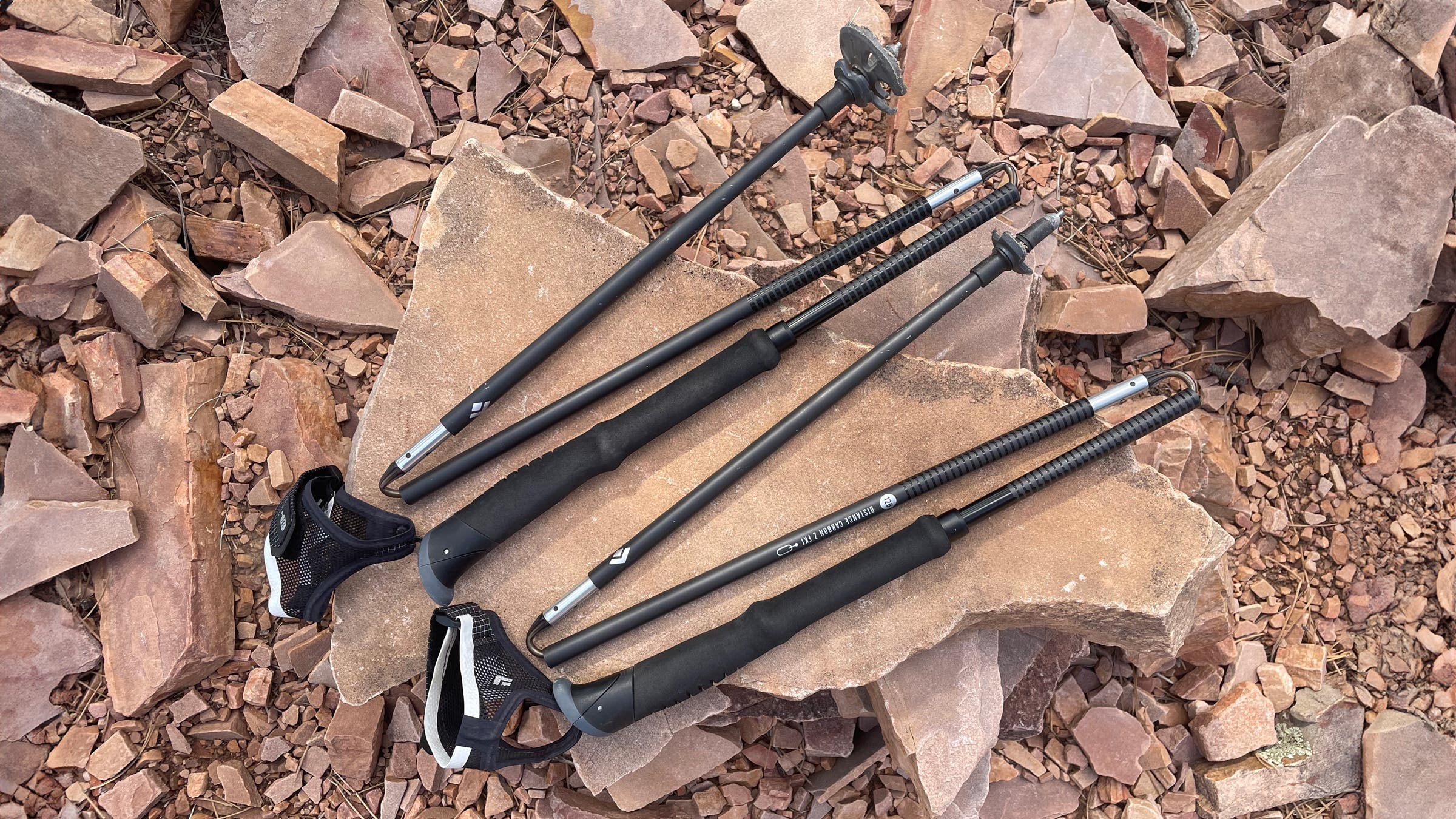
Black Diamond Distance Carbon Z FKT
Weight: 300 grams for 110 cm length
Size Range: 105 cm–130 cm
Collapsed Length: 35 cm–42 cm
Pros and Cons
+ Narrow pole diameter
+ Slim wrist strap
+ Break-down button easy to use
– Excess Velcro in strap
With 100% carbon fiber shafts, an EVA grip, and airy mesh hand/wrist straps, the Black Diamond Distance Carbon Z FKT poles are about as lightweight and minimal as poles can get. My size 120-centimeter (42-inch) poles weigh 11 ounces for the pair, and the swing weight is barely noticeable, minimizing upper body fatigue. The poles proved durable and stiff enough to support me in boulder fields and steep climbs on rocky scrambles without any sign of strain or breakage.
The poles unlock and fold down easily into three segments (the longest is 39 centimeters, about 15 inches) that stay connected thanks to an interior cord. Deployment is also quick and easy. The pole unfolds, snaps into place, and locks with a simple button mechanism.
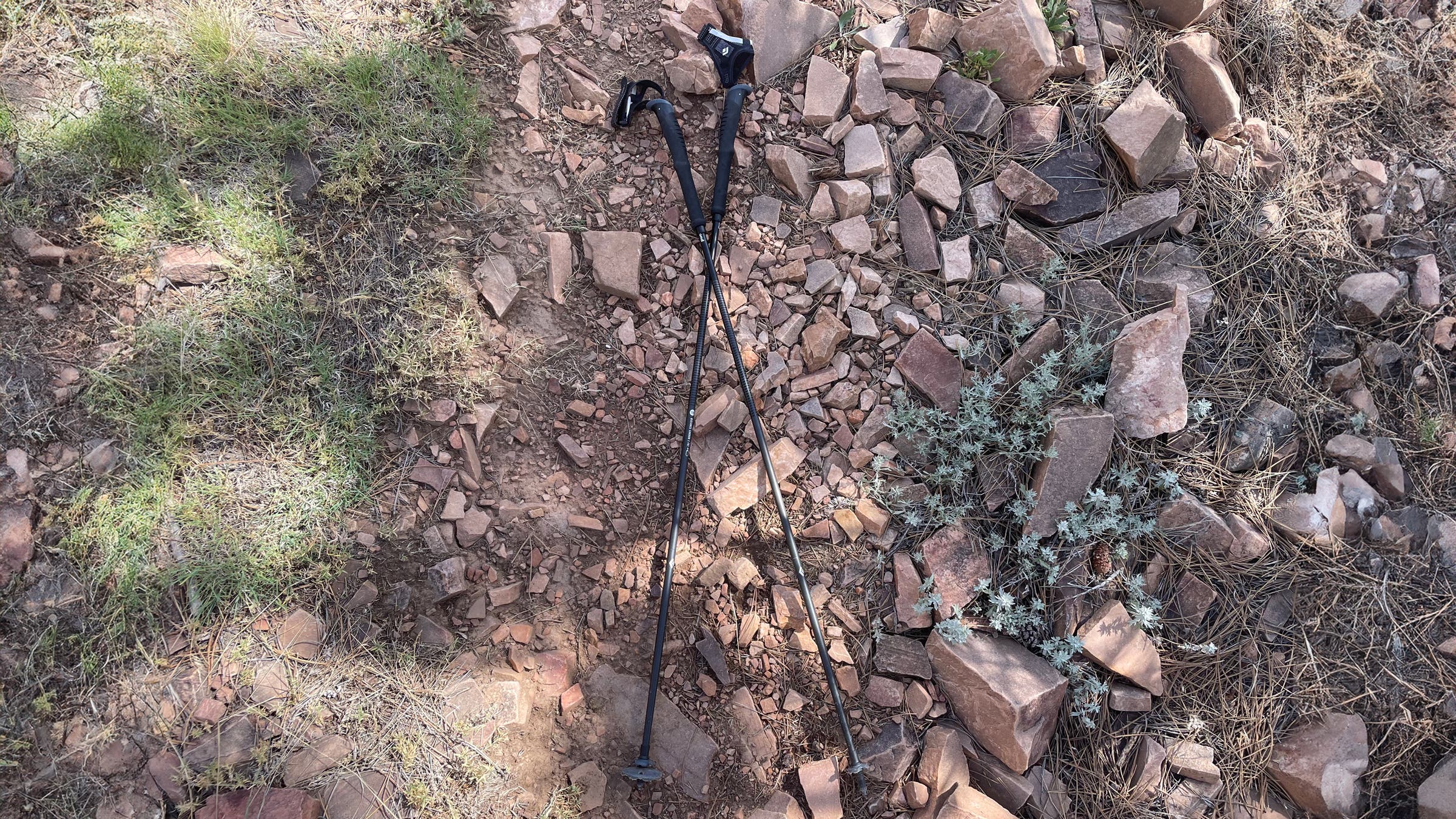
Both this and the Leki pole have detachable hand/wrist straps, meant to be worn for the duration of a run or adventure, whether you’re using the poles or carrying them folded up on your back. This design allows for quicker on-and-offs and more direct power transfer from arm strength to pole than using a basic strap that slides over the wrist.
ADVERTISEMENT
The most interesting thing about the Black Diamond poles is the magnetic attachment between the wrist straps and the handle. While wearing the wrist strap, you slide a small magnetic piece into the top of the handle and click it into place. To unlock the strap, you simply push down on the top of the handle with your thumb and the magnetic piece releases. I found this relatively easy, but I did need to look at what I was doing to align the magnetic piece into its housing.
Pros
I love that the shaft of these poles, at the thickest segment near the top, is still only about as thick as a Sharpie pen. They’re narrower in diameter than the Leki poles I tested, making them easier to carry in my hand, particularly when folded. I liked the smaller silhouette of the Black Diamond hand/wrist strap better than the larger footprint of the Leki strap, and found it more breathable. I also like how the button that locks the assembled pole in place is a tapered oval shape; it’s easy to compress, taking minimal effort when collapsing the poles.
Cons
I’m tall (5’8″) but have women’s size medium hands. Since the wrist straps come sized according to the length of the pole, the strap that came with the 120-centimeter pole is a little big for me. The excess Velcro strap hangs over slightly annoyingly on the palm side of my hand, just below where the pole grip rests. It also snags on my clothing when I have it all the way tightened to fit my hand.
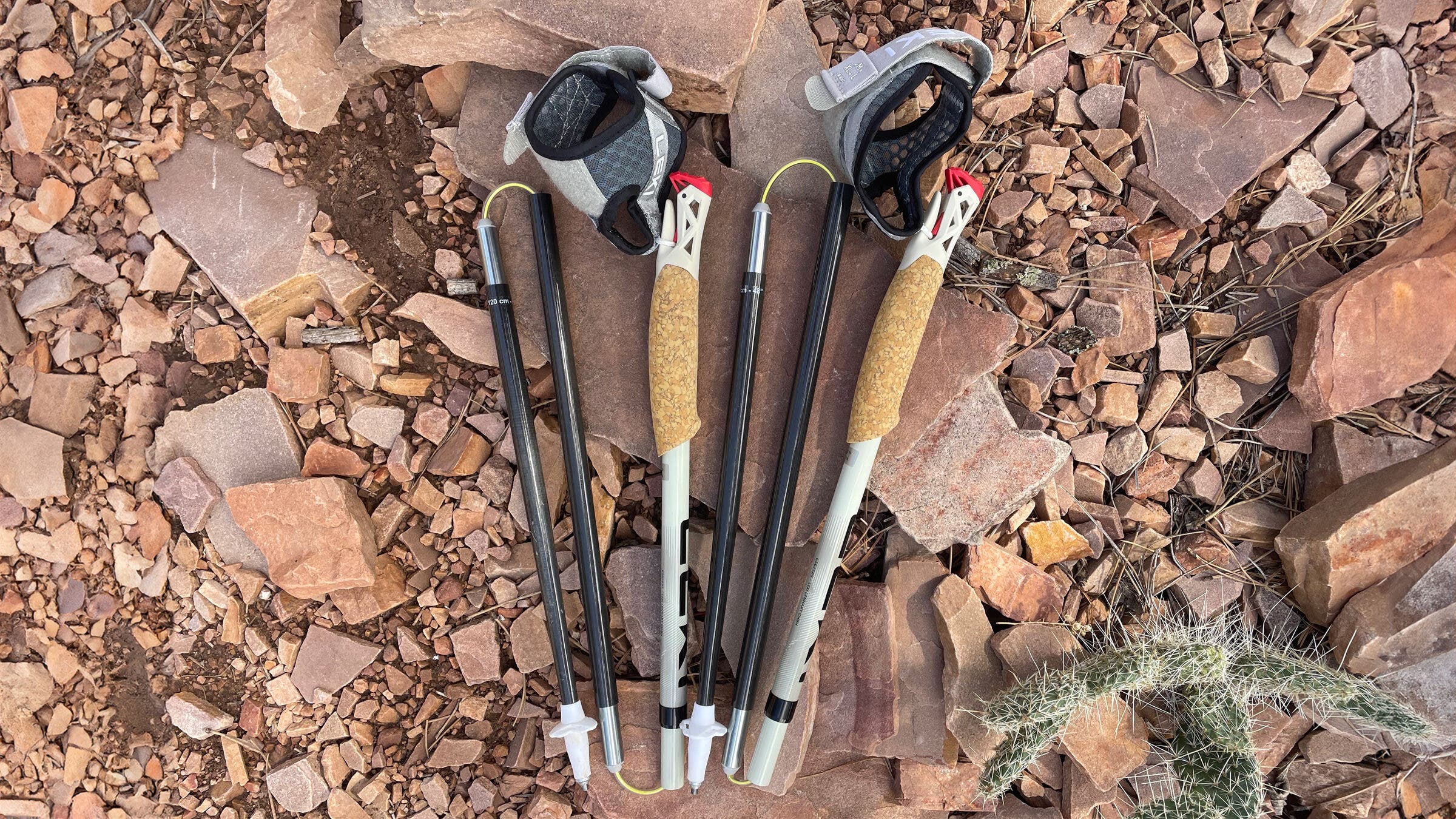
Leki UltraTrail FX.One At-a-Glance
Weight: 316 grams for 110 cm length
Size Range: 110 cm–135 cm
Collapsed Length: 35 cm–43 cm
Pros and Cons
+ Short folded length
+ Strap attachment locks easily
+ Strap feels soft and fits comfortably
– Unlocking button hard to push
Like the Black Diamond poles, the shaft of the Leki UltraTrail FX.One is made of carbon fiber, which has an amazing strength-to-weight ratio. These poles are wider in diameter than the Black Diamond, and they weigh a tiny bit more: 13 ounces per pair for my 120-centimeter (42-inch) poles. I didn’t, however, notice the difference in swing weight when in use. The Leki poles also fold down into three segments, connected by an interior cord, and unfold and lock into place. These poles fold down slightly smaller than the Black Diamond model; I measured the longest segment at 37 centimeters (compared to the Black Diamond’s 39 centimeters) when collapsed.
The connection for the Leki UltraTrail FX.One’s detachable hand/wrist strap is a loop that slides over a thumb-like piece of plastic and locks and unlocks easily. In fact, when I was tired and bumbling around, this system was easier to get in and out of than the Black Diamond’s magnetic attachment. I barely had to glance at the connection area to attach the Leki hand strap.
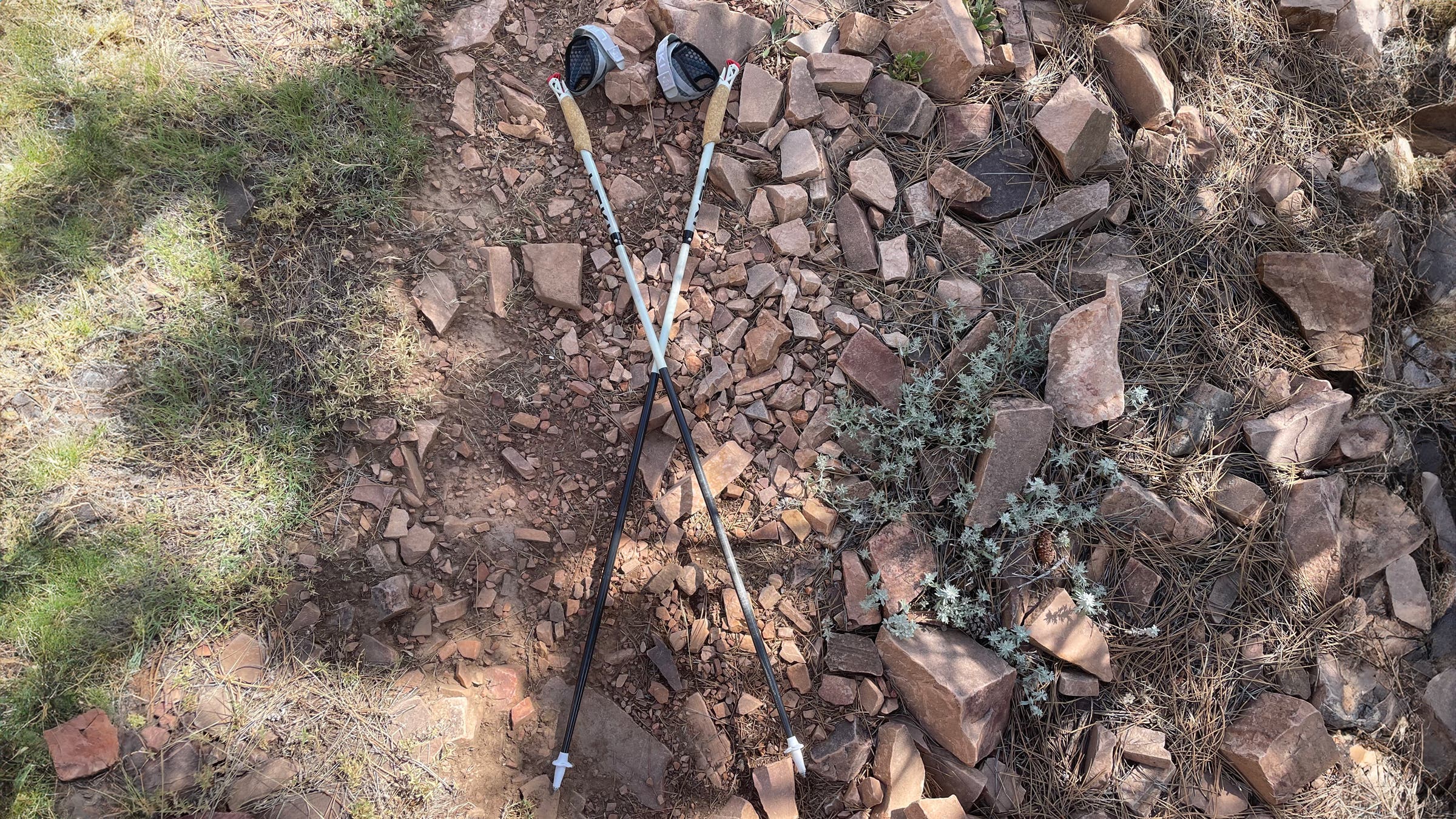
The Leki’s grip is made of skin-friendly cork, but you feel the wrist/hand strap more than the handle itself. The straps are made of soft, breathable mesh reinforced with fabric overlays, and have a larger surface around the hand than the Black Diamond straps.
ADVERTISEMENT
Pros
Connecting and disconnecting the wrist/hand strap to the pole is easy, requiring minimal focus. The strap fits my hand better, even though, like with the Black Diamond, it’s a large/XL because it’s sized by pole length and I’m tall. While it also has overhanging Velcro, it somewhat sticks to the soft mesh, keeping it out of my way. Another plus: the Leki poles cost $60 less than the Black Diamonds.
Cons
The larger surface area of the hand strap was less comfortable for me than the Black Diamond’s thinner strap, and the thicker diameter of the pole shaft makes it slightly harder to carry the poles in my hand, whether folded or not. I also found the locking button that releases the pole so it can be folded is a little harder to compress than on the Black Diamond pole. It’s a single round button that requires forceful pressure.
Which Trekking Pole for Runners Should You Choose?
Both of these poles are remarkably light and strong, fold down compactly, and assemble easily on the fly. Both strap systems work effectively. The choice comes down to small personal preferences in weight, pole width, collapsed length, locking mechanisms, and strap fit and comfort.
ADVERTISEMENT
For trail adventures where speed isn’t an issue, I’d probably skip both and reach for an older pair of collapsible poles with the looped wrist strap instead of wearing one of these wrist/hand strap systems for my entire run. But anytime I want to be moving as quickly and efficiently as possible, both the Black Diamond Distance Carbon Z FKT and Leki UltraTrail FX.One are solid choices—quick, light, and efficient partners in adventure.